


Cost pressures arising from MySuper could split the default superannuation market into cheaper and more expensive funds that deliver varying investment returns to consumers.
Some super funds will set low caps for investment costs and others will pay more as they seek better returns net of fees for MySuper members, says Paul Costello, the former chief executive of the $77-billion Future Fund, who consulted the government and industry on legislating the new regime for default super.
Watch Paul Costello, who led the MySuper consultation between government and industry, speak about cost and value in default superannuation funds at investmentmagazine.com.
Costello, currently non-executive chairman of buyout firm Blackstone in Australia and part-time associate commissioner with the Productivity Commission, says funds will likely develop a consensual investment cost for MySuper funds and then split into two camps: those sacrificing performance to sell cheaper products and the others paying more for better returns.
“Many institutions are likely to say: ‘That’s where we stand, that’s part of our headline offer, there are some things that we will exclude because it will threaten that hard line,’” Costello said at the Fiduciary Investors Symposium, a conference run by Conexus Financial, publisher of Investment Magazine, on May 16.
“Others will take a different path and say: ‘If we were to collectively agree to take another 20, 30 or 40 basis points, we genuinely believe that we will be able to reduce the amount of uncertainty in the outcomes and give people much more predictability in the journey.”
Early political and media commentary on MySuper, the legislation for new default funds from July 2013 that is part of the federal government’s Stronger Super reforms, said that the funds will be simple and cheap. This emphasis mellowed by the time Jeremy Cooper handed the MySuper recommendation to government as part of the Super System Review that he led.
| The MySuper concept is aimed at lowering overall costs while maintaining a competitive, market-based, private sector infrastructure for super. |
“The MySuper concept is aimed at lowering overall costs while maintaining a competitive, market-based, private sector infrastructure for super. The concept draws on and enhances an existing and well known product (the default investment option). MySuper takes this product, simplifies it, adds scale, transparency and comparability, all aimed at achieving better member outcomes,” part one of the review says.
To read the latest on MySuper from the Australian Prudential Regulation Authority (APRA), click the box below.
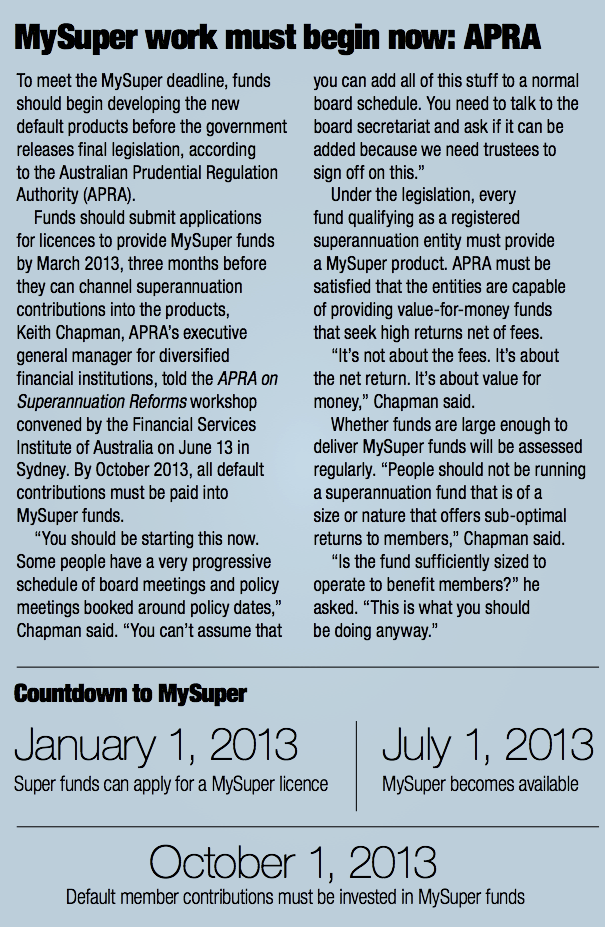
The cost of value
During the 2011 consultations, MySuper morphed from a “simple, low-cost product” to a default super fund that is more “thoughtfully constructed,”Costello said.
This change of focus, while supported by industry supervisor the Australian Prudential Regulation Authority (APRA), has not been well publicised.
“This point – which isn’t well understood by the media, is therefore not well understood by the public or even the industry – continues to focus on the fear of what MySuper will become, which is to provide the cheapest, the simplest and arguably the most dumbed-down product of them all,” Costello said.
“APRA frets about the lack of any clear deal between the investor and the provider. I think they will enthusiastically be prosecuting this point about trying to get the industry to be much clearer about what it’s doing, to report much more regularly about its progress against those objectives, and how we compare against our colleagues in achieving those goals.”














Leave a Comment
You must be logged in to post a comment.